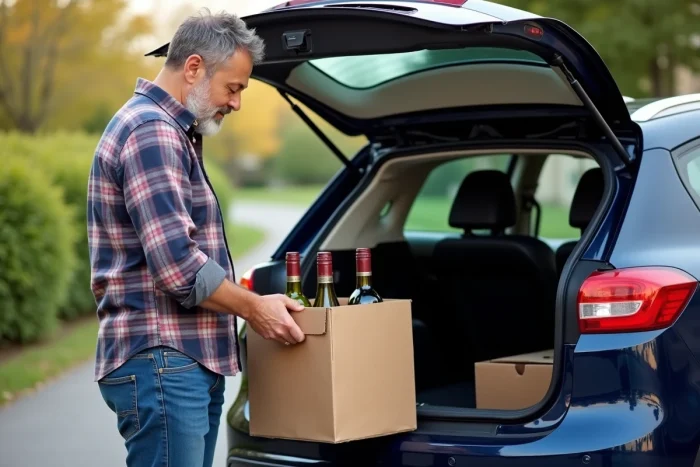
A trunk filled with bottles is not illegal. However, the atmosphere changes completely if the quantity becomes suspicious, especially when returning from abroad or during bulk purchases. As long as what you are transporting stays within the limits and is for personal use, no one has a reason to stop you. But exceeding certain volumes immediately raises attention: a cargo that is too large and suddenly, questions follow one after the other. If the answers are not convincing, the penalty is imposed without hesitation.
Before loading all the boxes into the trunk, it’s better to know exactly where the tolerance ends. Beyond a certain threshold, customs officers are particularly attentive, especially when returning from abroad or during collective orders. To cross the border without incident and drive with peace of mind, always keep these limits in mind:
- 90 liters of wine
- 10 liters of spirits
- 20 liters of aperitif beverages
Exceeding these quantities immediately arouses suspicion. It’s no longer just a matter of numbers: agents then examine every detail, from the receipt to the regularity of trips or the actual destination of this stock. If the story doesn’t hold up or if a document is missing, the outcome is a fine, seizure of alcohol, and sometimes, proceedings for suspected illegal trade.
What the law scrutinizes during a check
Transporting enough to liven up a family party is not random. But accumulating bottles, multiplying border crossings, or presenting vague justifications is where problems arise. Everything then depends on compliance with the legal limit for transporting alcohol in a car. When a check occurs, it’s hard to beat around the bush: if the explanations falter, the authorities confiscate the goods, impose an immediate penalty (up to €750), or even immobilize the vehicle. Going up the line to court is no longer a fantasy.
Within the European Union, every adult benefits from specific references: 90 liters of wine, 110 liters of beer, 10 liters of spirits, 20 liters of aperitif beverages. As soon as the crossing occurs outside the EU, the thresholds drop sharply: for each adult, only 1 liter of spirits, 4 liters of wine, 16 liters of beer. Violating these limits immediately opens the door to a complete check of the journey, invoices, and especially the true intention behind this stock.
Customs officers do not limit themselves to accounting: they check who is traveling, the possible presence of minors, ask questions about the place of purchase, and demand concrete proof. Transporting alcohol to or in the company of a minor is prohibited. As for the driver, the tolerance does not budge an inch: a maximum of 0.5 g/l of blood alcohol for experienced drivers, 0.2 g/l for recent license holders. A clear red line, with no exceptions.
How many bottles before the alarm signal?
The origin of the purchases determines the level of risk. To travel smoothly between European countries, these limits must be respected:
- 90 liters of wine, including up to 60 liters of sparkling wine
- 110 liters of beer
- 20 liters of intermediate beverages
- 10 liters of spirits over 22%
As soon as you cross a non-European border, the margins shrink:
- 4 liters of wine
- 16 liters of beer
- 2 liters of beverages under 22%
- 1 liter of spirits over 22%
There is no question of mixing categories: each is calculated separately, and only adults count. Any uncertainty about the destination of the bottles or a vague justification, and the axe falls: products confiscated, fines, or even vehicle blockage if the dialogue stalls.
Crossing the border: how to avoid a slip-up
In practice, crossing a European border with alcohol in the trunk requires no special paperwork. On the ground, checks mainly rely on quantities, invoices, and the consistency of explanations. At the slightest doubt, each box is checked, every element of the story scrutinized. The accuracy of the narrative weighs as heavily as the liter count.
As soon as you enter France, national legislation takes precedence, with no leeway. If the invoice is unclear or the justification diverges, the case closes quickly: back to reality with a fine and possible confiscation.
Coming from a country outside the EU, the line is even stricter. The slightest excess results in automatic taxation, and any overage systematically ends in seizure, with no negotiation.
For a family party or a birthday, temporarily storing at home does not attract any reprimand, as long as transparency and moderation are upheld. But making repeated trips casually or downplaying the quantity is playing a risky game with the inspectors. Often, it only takes an imprecise explanation or one box too many for a festive project to quickly turn into a customs disaster.