A Persian rug placed in a loft in the Marais, a Moroccan lantern alongside the brushed steel of a designer kitchen: the oriental style does not negotiate its place, it invites itself in and settles, effortlessly and without compromise. These collected pieces seem to transcend time, indifferent to fleeting trends, finding refuge in contemporary interiors with a silent confidence.
But how to go further: are we trying to stick closely to heritage or do we prefer to experiment, cross, and mix influences and materials? At a time when minimalist furniture and travel souvenirs intertwine, the boundary no longer really exists. The oriental spirit allows for all audacity, combining past and present in a new rewriting of home decor.
Why oriental decoration is increasingly appealing in modern interiors
Oriental decoration asserts itself in living rooms and bedrooms: it evokes authenticity and warmth, those resources we seek to bring home. Its allure comes from its diverse origins—Morocco, Tunisia, Turkey, Egypt, or Persia—willingly breaking the norms of Western design. The influences of the Middle East and North Africa express themselves through the generosity of fabrics, the dialogue between bold colors and raw materials, and patterns that defy the monotony of straight lines.
Here, nothing feels heavy. Contemporary oriental decor avoids the multiplication of objects. It prefers precision: a Berber rug that energizes a light floor, a perfectly laid zellige as a backsplash, a forged lantern hanging in a minimalist space. Persian rugs, embroidered cushions, or low benches become central. Not merely for aesthetics, but to give an identity, to enhance your interior deeply.
Many today explore oriental codes to better organize their space, merging a touch of the Mediterranean with a bohemian breath. Handcrafted objects hold a special place, whether inherited or brought back from a journey, to create a home that speaks of change and everyday life mixed with exoticism.
To go further in this approach, it’s best to surround yourself well: there are platforms where inspirations, artisan portraits, and insights into the latest trends mingle. For those looking to take the plunge or simply nourish their decor ideas, just discover the Deco Asaiss website, a true source of ideas and a gallery dedicated to the art of living in the oriental style, in its current version.
What are the keys to an authentic and warm oriental ambiance at home?
This style takes on its character from the emphasis placed on know-how and noble materials. Craftsmanship marks every detail: Berber rugs from Morocco, Anatolian kilims, Iranian weavings… all these fabrics tell fragments of life, transforming a room without weighing it down. On textiles, furniture, or walls, arabesques and geometric patterns create a subtle thread.
Muted and powerful colors assert themselves: ochre, deep red, turquoise, emerald, caressed by copper or gold touches. Low seating, piled with embroidered or satin cushions, invites relaxation. A sculpted coffee table, made of pierced metal or turned wood, quickly becomes the focal point for conversations, tea trays, and everything that embodies hospitality in the oriental style.
Lighting, again, plays a role in setting the mood: airy lanterns, candle holders, and hand-woven suspensions mix shadows and light. In every room, no detail is overlooked. Handmade accessories, baskets, ceramics, or brass trays, highlight the decor without ever succumbing to excessive collection.
The walls also find their place: the moucharabieh adds depth, the tadelakt displays its mineral strength, and the zellige mosaic reflects the typical refinement of Moroccan design. The accumulation of authentic objects, exclusively chosen for their history and uniqueness, builds a welcoming atmosphere where each element easily finds its place.
Objects, colors, and decor tips: drawing inspiration without falling into clichés
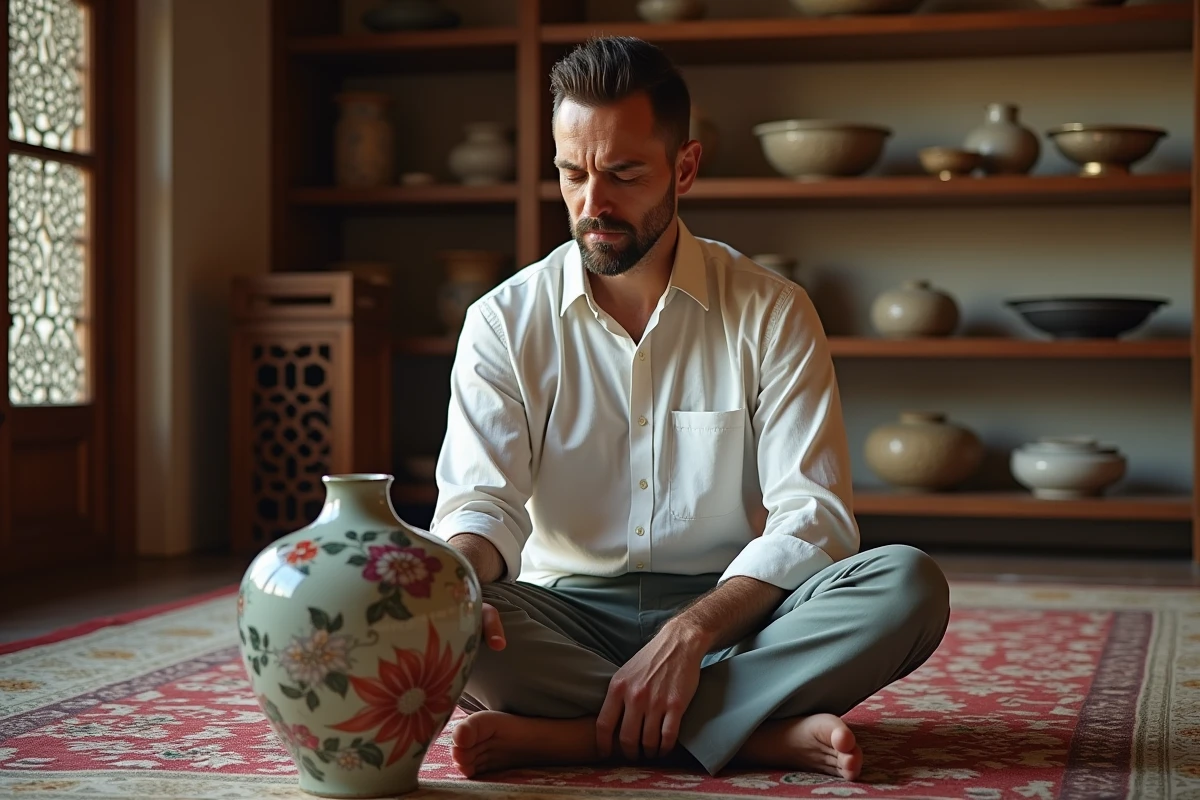
Creating a true oriental decor requires stepping away from ready-made ideas. It’s not about amassing. A few objects have more impact than a thousand trinkets: quality, provenance, and history outweigh quantity. We then turn to pieces that discreetly command attention: an oriental painting (calligraphy, mandala, triptych), patterned cushions, or a colorful ceramic are often enough to define the ambiance.
Depending on your desires, you can prioritize the following axes to anchor this style without force or heaviness:
- Introduce typical colors such as ochre, terracotta, deep red, emerald, or turquoise, as accents against a light background.
- Consider including low furniture and minimalist designs, dressed in embroidered covers, simple tablecloths, and hammered copper trays.
- Highlight the atmosphere with a brass mirror or a crafted metal sconce that softens the light.
A beautifully hammered tea tray, a few wicker baskets, a raw clay vase set the scene without grandiosity. Paired with linen drapes, a graphic Berber rug, or sheer curtains, these elements create a conversation between tradition and modernity. No forced accumulation here; each detail breathes. Gradually, a unique art of living emerges, both contemporary, authentic, and unadorned. You open the door, light glides over a mosaic, and in an instant, another place settles before our eyes.