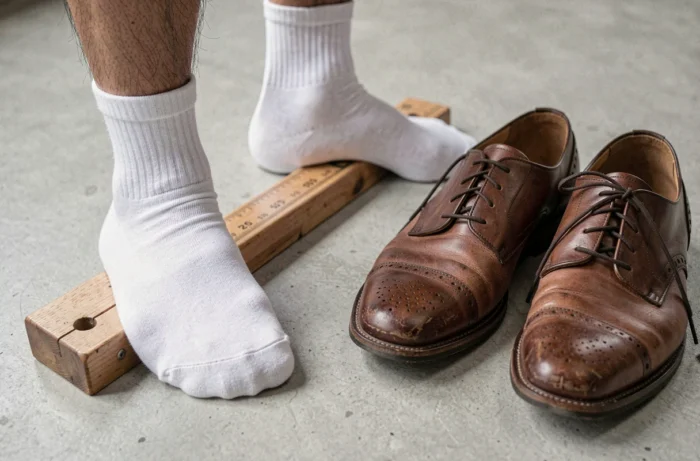
The size printed on a shoe does not describe the shape of the foot, let alone how comfortable it feels. Several factors, from foot width to differences between manufacturers, limit the usefulness of any statistical average.
Why EU shoe sizes don’t really measure the foot
The European shoe sizing system (EU) is not a direct measurement of foot length. It is based on the Paris point, a unit equal to two-thirds of a centimetre, applied to the length of the insole rather than the bare foot. As a result, two feet of identical length may be assigned different sizes depending on the shoe’s shape and the extra allowance added by the manufacturer.
The Mondopoint system, governed by ISO 9407:2019, takes a different approach. It sizes shoes based on the foot’s dimensions in millimetres, including both length and width. This system is used for some sports and military equipment, but remains uncommon in mainstream retail.
Conversion charts for EU, UK and US sizes are indicative, not universal. An EU 42 does not always correspond to the same US 8.5 across brands. An article detailing the average shoe size for men confirms that the 42–43 range remains a statistical benchmark, but how comfortable it feels depends on factors that shoe size alone cannot capture.
Foot width: the factor missing from shoe labels
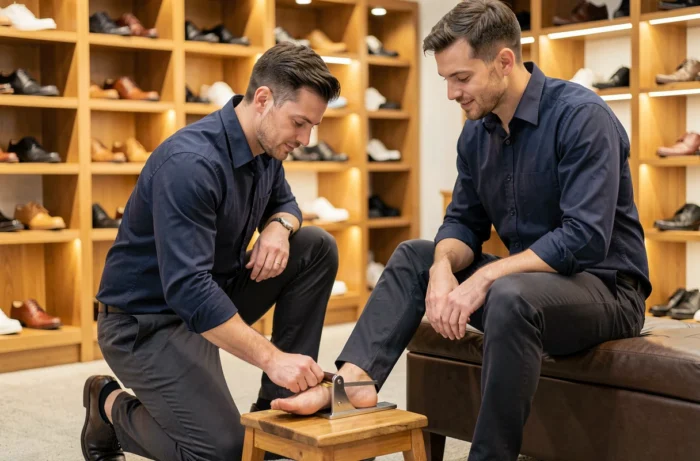
Two men who wear size 43 can have very different foot shapes. One may have a narrow foot, while the other has a wide foot with a high-volume forefoot. As displayed in stores, shoe size only indicates the estimated length.
Width is a shoe-fitting dimension in its own right. The Mondopoint system includes it by default, specifying both foot length and width in millimetres. A few specialist brands offer different widths (often labelled E, EE or H for wide-fit models), but mainstream retailers almost always list size alone.
This omission has direct consequences. A man with wide feet who buys a standard size 43 may feel pressure on the sides, even if the length is right. He may then go up a size to gain room, which throws off the length and creates another problem: the foot slides forward. Going up a size to make up for insufficient width compromises support and can cause heel rubbing.
Measure both feet, not just one
Measuring guidelines emphasise a point that is often overlooked: measure both feet while standing and bearing weight, then use the larger measurement. The longest toe is not always the big toe. For some foot shapes (known as “Greek feet”), the second toe extends furthest, affecting the usable length.
- Stand with your foot flat on a sheet of paper, your weight evenly distributed across both legs, and trace around it with a pencil held vertically
- Measure from the heel to the longest toe, then repeat the process for the other foot
- Use the larger measurement and compare it with the chart for the brand you’re considering, not a generic chart
This method may seem simple, but it gives a more reliable result than relying on the size you habitually buy out of reflex.
Differences between brands: why a size 42 isn’t always a 42
Differences in fit between brands are well documented by retailers and podiatrists. ISO 9407:2019 governs the Mondopoint system, but it does not standardise other shoe sizing scales. Each manufacturer sets its own tolerances for the shoe last, comfort allowance and sole shape.
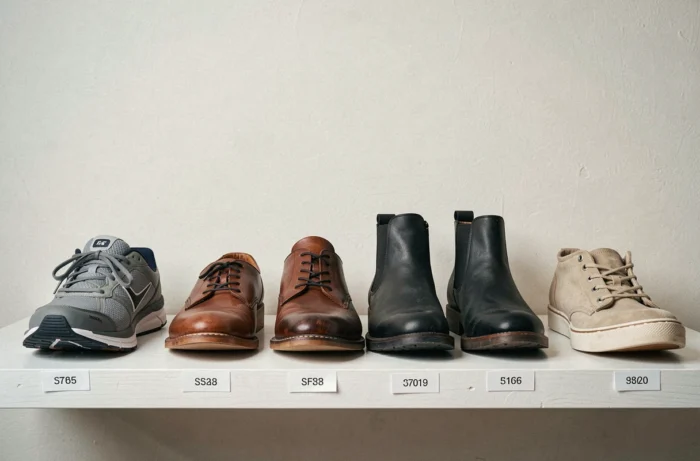
A classic leather derby from a French manufacturer may fit shorter than a sneaker from an American brand displaying the same size. Sports shoes often include extra room for foot movement, making them seem to “run large”. Dress shoes, by contrast, tend to have a closer fit.
This variation makes the idea of an “average shoe size” even more relative. Saying that the average men’s size is 42–43 does not predict which size will fit in a particular brand. The only reliable constant is foot length measured in centimetres or millimetres, checked against the manufacturer’s specific size guide.
How men’s shoe sizes have changed: are feet really getting bigger?
The idea that men’s feet have grown over the decades comes up regularly. Shoe manufacturers and some retailers report that the most popular sizes have increased compared with the 1970s and 1980s. Sizes 44 and 45 now account for a growing share of sales.
The most commonly cited explanation is general improvements in nutrition and health, which have led to an increase in men’s average height. Larger feet naturally accompany taller bodies. Rising rates of overweight and obesity also play a role: greater body weight spreads the foot under load, prompting some shoppers to choose larger sizes.
What the data still doesn’t tell us
Public data on changes in men’s average shoe size remain patchy. Large-scale anthropometric studies focus more on height than on foot dimensions. No French national database systematically tracks average shoe size over time.
Figures cited by brands are based on their own sales, which introduces bias: if a retailer expands its range to include larger sizes, its average sales size will rise automatically, even if the population’s foot shape has not changed. The lack of standardised nationwide measurements limits the validity of claims about a “historical increase” in shoe sizes.
Whether it is put at 42 or 43, the average men’s shoe size remains a useful commercial benchmark for stock and logistics. For individual comfort, however, it has limited value. Measuring your feet in millimetres, taking width into account and checking each brand’s size guide before buying: these three steps are far more useful than any general statistic.