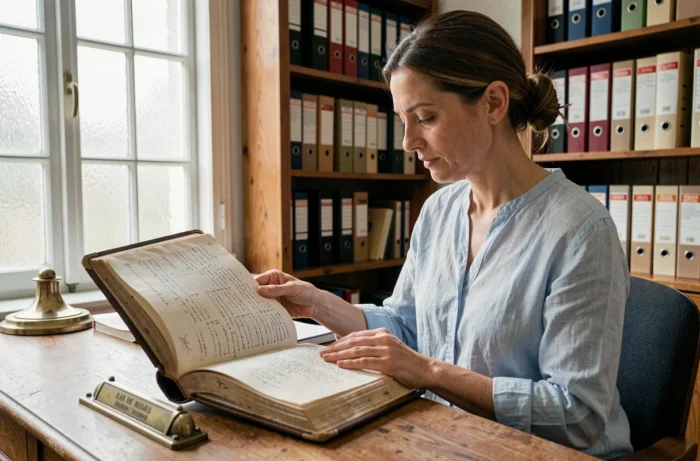
In France, civil status is maintained by each municipality. Birth, marriage, and death registers are kept at the town hall and are then transferred to the departmental archives after a certain period. Accessing a nominative list of marriages celebrated in a given municipality requires understanding this administrative organization, the rules of document accessibility, and the available digital tools.
Accessibility of marriage records: deadlines to know before any search
Before searching for a record or a list of marriages, it is important to know that not all civil status records are freely accessible. The law sets deadlines for accessibility that protect the privacy of the individuals involved.
For marriage records, the public accessibility period is 75 years from the date of the record. In practice, a marriage celebrated after 1950 will generally not be available for free consultation on online archive portals.
For more recent records, requests must be made directly to the town hall where the marriage took place. Only certain individuals (the spouses themselves, their ascendants or descendants, or authorized professionals) can obtain a full copy of a recent record. Finding the list of marriages by municipality in France therefore involves different channels depending on the period being searched.

Online departmental archives: consulting digitized marriage registers
The departmental archives are the main resource for accessing old marriage registers. The vast majority of French departments have digitized their civil status records and make them available for free on their websites.
Accessing digitized registers department by department
Each department has its own online archive portal. Navigation varies from site to site, but the principle remains the same: select a municipality, a type of record (here, marriages), and a period.
- Go to the website of the departmental archives of the relevant department (search by the name of the department followed by “archives en ligne”).
- Access the “civil status” or “digitized registers” section, then select the municipality and the type of register desired.
- Consult the decennial tables, which summarize all marriages celebrated over a ten-year period in alphabetical order, to quickly locate a specific record.
- Once the marriage is identified in the table, note the year and the record number to find the complete record in the corresponding register.
The decennial tables are a valuable research tool. They help avoid flipping through every page of an annual register and function like an index.
The absence of a unified national portal
There is no national database that groups all marriages by municipality. The FranceArchives website, managed by the Interministerial Service of the Archives of France, references the various departmental portals but does not centralize the records themselves. Each search must therefore be conducted department by department.
This fragmentation is explained by the historical organization of French civil status: the registers are kept in duplicate, one retained at the town hall and the other transferred to the court registry and then to the departmental archives. The network remains local.
Town hall and marriage banns: accessing recent information
For recent marriages (less than 75 years old), the town hall of the celebration municipality is the direct contact. Two types of information are accessible through this channel.
The marriage banns constitute the official publication of a proposed union. They are displayed on the town hall’s information boards for ten days. Some municipalities also publish these banns on their websites, but this practice is neither mandatory nor systematic.
To obtain an extract or a copy of a recent marriage record, the request can be made online via the service-public.gouv.fr website, by mail, or directly at the counter of the relevant town hall. The service is free.
Insee statistics and municipal data: what they really allow
The Insee publishes statistical data on marriages in France, broken down by municipality. These tables provide information on the number of marriages celebrated each year in a municipality, the demographic characteristics of the spouses (age, previous marital status), and the evolution of the number of unions over several years.
This data does not constitute a nominative list. They do not mention the names or specific dates of each marriage. Their usefulness lies in demographic analysis or comparison between territories, not in the search for an individual record.
Another point worth noting: intercommunal groupings can alter the scope of a search. A new municipality, resulting from the merger of several former municipalities, consolidates the data under a single Insee code. To find marriages celebrated in an old municipality before the merger, it is necessary to identify the administrative name in effect at the time and search in the corresponding archives.
Collaborative genealogy platforms: a useful complement
Platforms like Geneanet or Filae index civil status records based on data collected by volunteers or partnerships with the archives. These databases can sometimes help locate a marriage more quickly than flipping through digitized registers image by image.
Access to advanced search features is often paid. The reliability of the records depends on the work of contributors: always verify a result by consulting the original record at the departmental archives or town hall.
These tools are particularly useful for genealogical research covering multiple municipalities or departments, as they allow for cross-querying that archive portals, designed department by department, do not offer.
Searching for marriages by municipality in France therefore relies on three distinct pillars depending on the targeted period: digitized departmental archives for old records, town hall for recent records and banns, and Insee data for aggregated statistics. No single counter currently brings together all this information, making knowledge of the right search channel as crucial as the search itself.