The wedding market in France is undergoing a rapid restructuring phase. Formats are evolving, budget items are being redistributed, and new service providers are emerging in the value chain. Far from being a mere trend, these movements reflect concrete choices made by couples regarding the size, duration, and content of their reception. An overview of wedding trends that are reshaping the industry.
Wedding content creators: a new line item in couples’ budgets
Among the least documented changes, the emergence of content creators specializing in weddings deserves separate analysis. According to the Vows & Venues study conducted by Hyatt among 2,000 people and reported by Le Journal des femmes in September 2026, content creators are establishing themselves as a new category of service providers alongside photographers and videographers.
Their mission is not to be confused with that of the traditional videographer. They produce vertical videos designed for almost immediate sharing on social media. Couples are no longer just looking to preserve memories, but also to share them in the hours following the ceremony.
This shift raises several concrete questions. The budget allocated to imagery is mechanically increasing, as the content creator complements (and does not replace) the photographer. Field reports vary on this point: some couples choose to reduce traditional photo coverage, while others simply add a line to the overall quote. By following the news from Mon Beau Mariage, one can gauge how this transformation in the imagery budget is reshaping organizational priorities.
Intimate receptions and wedding budgets: the paradox of less but better
The trend towards more intimate weddings is confirmed by testimonies from professionals. Requests are leaning towards receptions of around 80 people, where the norm used to be around 200 guests. But reducing the number of guests does not mean reducing the total budget.
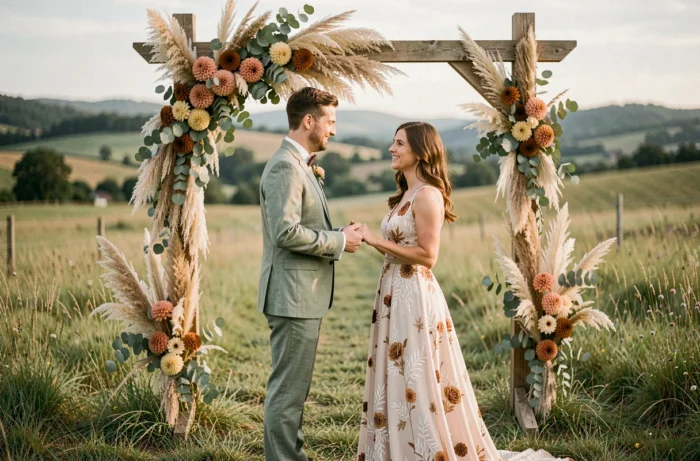
Couples are reinvesting the savings from the reduced volume into so-called “heart-stopping” items: high-end catering, unique venues, custom floral design. The choice is made in favor of quality per guest rather than the quantity of seats.
This mechanism produces a budget concentration effect. The cost per person rises, while the overall budget remains stable or decreases slightly. For service providers, the consequence is direct: couples expect a level of personalization and service that no longer corresponds to standardized offerings.
The wedding weekend as the dominant format
According to the Vows & Venues study by Hyatt, weddings are now extending over two days, including a brunch the following day. This evolution transforms the celebration into an extended experience for guests, with significant logistical implications.
Group accommodation, Saturday morning activities, Sunday brunch: each step generates additional costs and increased coordination. The weekend format also enhances the appeal for venues capable of hosting a complete stay (estates, castles, farms), to the detriment of urban reception halls for day events.
Eco-responsibility in weddings: beyond decoration
Environmental commitment in weddings has long been limited to choosing seasonal flowers or reusable tableware. Available data shows a shift towards a more structural issue: the logistics of travel now concentrates the eco-responsible effort.
Specifically, couples are starting to integrate into their planning:
- Grouping guests at the same accommodation site to limit individual car trips
- Choosing a reception venue accessible by public transport or located near the guests’ living area
- Carbon offsetting for long-distance travel, offered by some wedding planners as an option in their quotes
This approach goes beyond symbolic gestures. It involves rethinking the choice of venue in advance, sometimes at the expense of a dream estate that is geographically isolated. Field reports vary on the actual maturity of this practice: while sensitivity exists, the transition to action remains uneven across regions and budgets.
Style and wedding dress trends: what the 2026 shows confirm
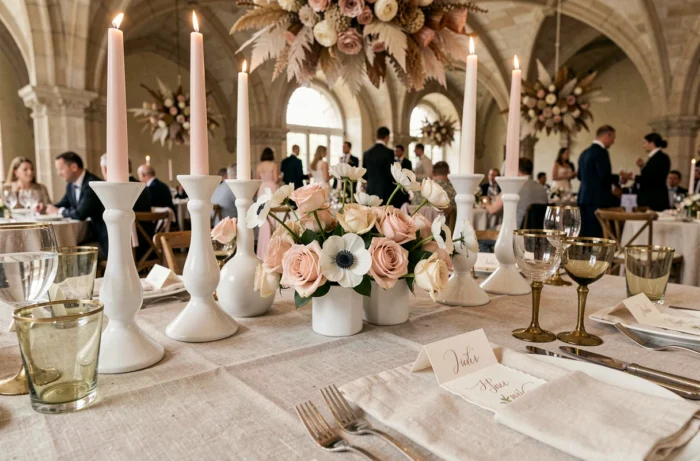
On the style front, two lines coexist without one clearly dominating. On one side, a minimalist aesthetic with streamlined wedding dresses, neutral colors, and understated staging. On the other, a clear return to more elaborate decor, with draping, generous floral compositions, and bold color accents.
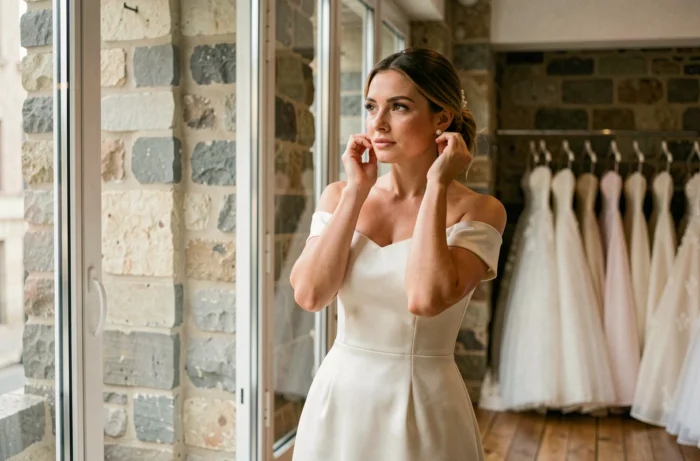
The wedding dress remains the ultimate emotional item, the one on which brides are least willing to compromise. Second-hand or vintage dresses are gaining visibility, driven by the eco-responsible wave, but they do not yet represent the norm.
Another signal to watch: the rise of so-called “unplugged” ceremonies, where guests are asked to put away their phones. The stated goal is to refocus attention on the moment experienced rather than its capture. In practice, the phone-free ceremony often coexists with an official content creator, the only one allowed to film.
The wedding film changes format
The traditional wedding film (a several-minute montage, music, slow motion) is gradually giving way to shorter formats. Couples are requesting clips of less than a minute, tailored for social media, delivered in the days following the event.
This shift alters the profile of sought-after videographers. Mastery of vertical editing, fast pacing, and the visual codes of social platforms becomes a selection criterion alongside cinematic quality.
The wedding as it is being prepared today looks less and less like the one from five years ago. Budgetary choices, ecological pressure on logistics, and the emergence of short digital formats are redefining what couples expect from their service providers. The upcoming season will confirm whether these trends stabilize or accelerate further.