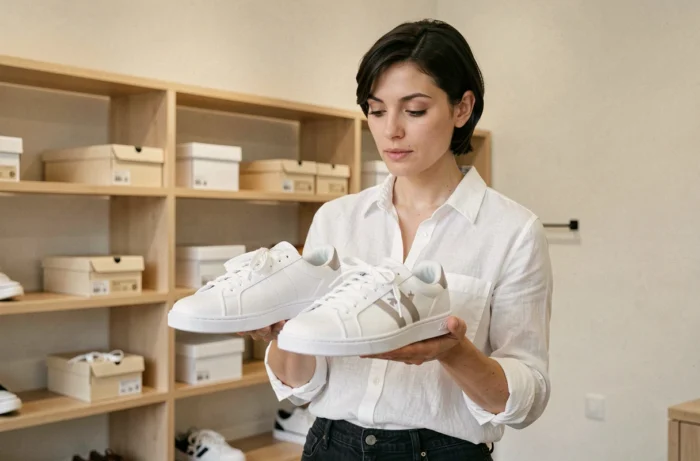
Recognizing authentic shoes is no longer just about turning the pair over and checking a logo. Counterfeits are improving in quality every year, and sales channels are diversifying to the point of blurring usual references. This article compares the verification methods available, from manual inspection to authentication technologies, to measure what really works against current copies.
Manual or Digital Authentication: Comparative Table of Methods
Two main approaches coexist to identify counterfeit shoes. Traditional physical inspection relies on sight and touch. Digital solutions (NFC, QR codes, artificial intelligence) promise faster verification. Their respective limitations deserve to be clearly stated.
| Criterion | Manual Inspection (multi-step) | Digital Authentication (NFC, QR, AI) |
|---|---|---|
| Verified Elements | Materials, stitching, smell, packaging, accessories, condition compliance | Embedded chip, unique code, brand database |
| Reliability on High-End Copies | High if performed by a trained expert | Depends on the integrity of the chip or code (can be cloned or absent) |
| Accessibility for the Buyer | Requires physical shipping or an appointment | Instant scan via smartphone |
| Coverage of the Secondary Market | Applicable to all pairs, even older ones | Limited to recent equipped models |
| Average Cost | Paid (third-party service) | Free if integrated by the brand |
The PUSHAS service specifies that its checks are performed manually, in several steps, on the shoe, accessories, packaging, and condition compliance. A single photo does not allow for verification of materials, smell, or finish. This is the main limitation of remote verifications.
For those who wish to delve deeper into the visual and tactile criteria specific to each brand, it is possible to learn more on Oh my shoe before investing in an expensive pair.

Stitching, Leather, and Finishing Details: What Copies Still Don’t Reproduce
Physical clues remain the foundation of any serious verification. On an authentic leather shoe, the grain shows natural irregularities. Genuine leather slightly absorbs moisture upon touch, while synthetic leather remains smooth and plastic-like.
Stitching serves as a reliable marker. On an original pair, the stitches are consistent, with no loose threads, and follow a constant line along the panels. Counterfeits often show tension discrepancies, doubled threads, or irregular finishes at the joints.
The Most Discriminating Checkpoints
- The alignment of the logo on the tongue and heel: a shift of a few millimeters, a slightly different font, or irregular spacing between letters signals a copy.
- The quality of the insole: on an authentic model, the imprint of the model number and date code remains clear, with no smudging. Counterfeits often use blurry markings or misaligned stamps.
- The weight of the pair: substitute materials (low-density foam, thin canvas) make the counterfeit noticeably lighter or heavier than the reference model.
- The smell: genuine leather emits a recognizable organic scent. Copies have a pronounced chemical solvent or new plastic smell.
Metal details also reveal the quality of manufacturing. Eyelets, buckles, or tips should have a satisfactory weight and uniform plating. On counterfeits, metal parts are often light, dull, or show signs of premature oxidation.
Sales Channels and Counterfeiting: Where the Risk Concentrates Today
The idea that counterfeits only circulate on obscure sites no longer reflects the reality of the market. A study by the UK Intellectual Property Office highlights an increasing reliance on major marketplaces and social networks in sales circuits related to counterfeits, while some small online retailers are relatively declining.
The seller’s profile becomes a verification criterion in its own right. A limited transaction history, lack of a clear return policy, or generic photos (identical to those of other listings) are concrete warning signals.
Local Production of Counterfeits: A Trend to Watch
The production of counterfeits tends to move closer to destination markets, according to an analysis based on OECD data. This geographical shift complicates upstream detection by customs, as intra-community shipments undergo fewer checks than parcels from areas traditionally associated with counterfeiting.
Purchasing on a platform with a buyer protection mechanism reduces financial risk but does not guarantee the authenticity of the received product. Third-party authentication services remain the only independent safety net.
NFC Technologies and Traceability of Authentic Shoes
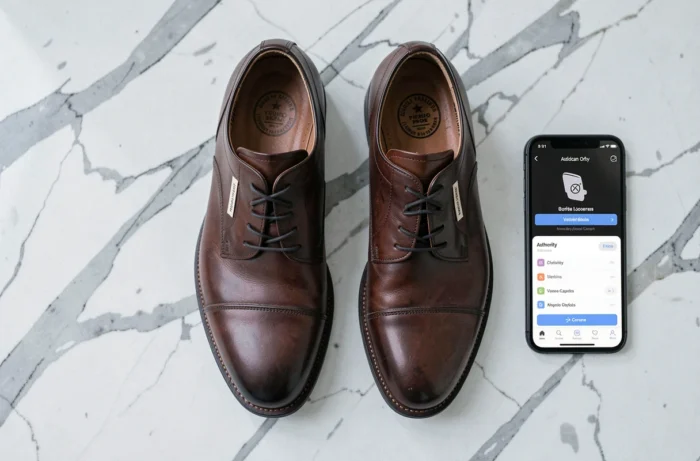
Several brands are now integrating NFC chips or unique QR codes directly into their products. The principle: each pair has a digital identifier linked to a manufacturer’s database, accessible via a smartphone.
This approach solves part of the problem for recent models. However, it does not cover the second-hand market for pairs predating the adoption of these technologies. Vintage pairs or older editions remain dependent on human expertise for their authentication.
A point of caution concerns the cloning of the NFC chips themselves. The most robust systems use dynamic cryptographic signatures, but low-end solutions relying on a simple static identifier can be reproduced. Technology alone does not replace a complete physical verification on valuable items.
The authentication of shoes still largely relies on the combination of physical examination and digital traceability. No single method is sufficient, and the gap between the two approaches is closing less quickly than the quality of counterfeits is advancing. Checking the seller, inspecting the finishes, and resorting to a trusted third party when the amount justifies it remains the most reliable sequence.